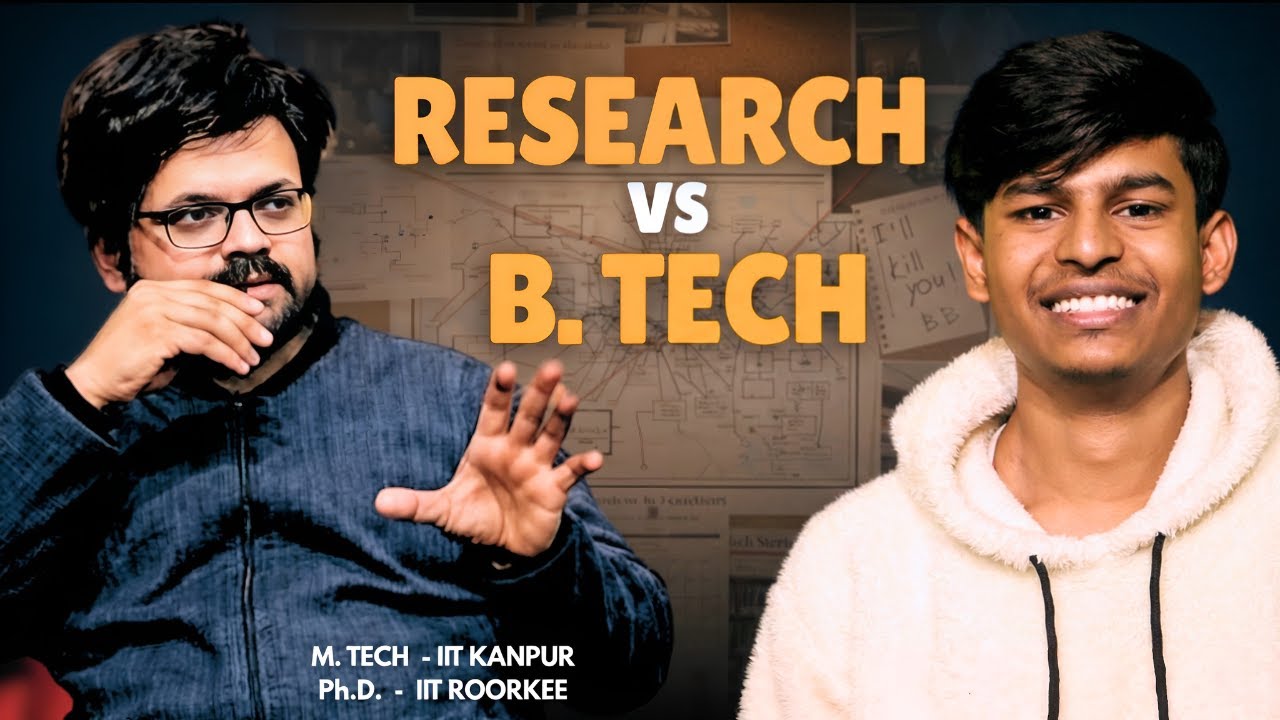
Job After BTech or Research? A Ground-Truth Conversation with Yash Tiwari
For many engineering students, the question arrives quietly — and then refuses to leave:
Should I take a job after BTech, or dive into research?
This interview with Yash Tiwari, a professor of quantum physics and robotics, cuts through the motivational noise and delivers something rarer: clarity.
Not encouragement. Not discouragement. Just reality — explained calmly by someone who has walked both paths.
Who Is Yash Tiwari?
Yash Tiwari is not a theorist speaking from a distance.
He completed his MTech from IIT Kanpur, earned a PhD from IIT Roorkee in Quantum Physics, and currently teaches quantum and robotics. Before fully committing to research, he also spent around 1.5 years working in the finance sector.
That detail matters.
His perspective isn’t academic idealism — it’s informed by real trade-offs, lived firsthand.
BTech and Research: Not Opposites
One of the first myths he dismantles is the idea that BTech and research are separate worlds.
They’re not.
You can pursue research after a BTech just as well as after a BSc. The difference lies in orientation:
- BSc leans deeper into theory and conceptual understanding
- BTech focuses more on application and industry readiness
In India, BTech is often preferred for placements, while BSc offers richer conceptual depth. But research remains open to both paths.
Yash himself is proof — you don’t need to “choose research early” to end up there.
The Personality Research Demands
Research is not a linear success story.
It’s closer to controlled failure.
Yash emphasizes that research demands:
- Extreme patience
- The ability to fail repeatedly without losing motivation
- Comfort with long periods of uncertainty
It’s a high-risk, high-reward path — but the reward is delayed and uncertain.
If quick validation, fast growth, or predictable outcomes matter to you, research can feel emotionally expensive.
The Financial Truth (That Most People Avoid)
This is where the conversation becomes uncomfortable — and honest.
Research is not financially rewarding in its early stages.
Stipends are limited. Progress is slow. Pressure is constant.
Yash is direct:
If you have heavy financial responsibilities or family pressure, research becomes mentally taxing. And a stressed mind does not do good research.
A sustainable research career requires financial cushioning — personal savings, scholarships, or a family situation that allows patience.
Without stability, even passionate researchers burn out.
India vs Abroad: Why So Many Leave
Yash doesn’t romanticize the global research ecosystem.
Many students pursue MTech or PhD abroad because:
- Funding is stronger
- Research is better valued
- Industry–academia collaboration is deeper
In India, research is often underfunded and undervalued. There’s also a tendency to replicate Western work rather than focus on indigenous problems.
Ironically, Indian institutions often prefer foreign PhDs — not for superiority, but because they bring global exposure and networks.
It’s not a talent problem.
It’s an ecosystem problem.
Jobs After BTech vs After PhD
A BTech degree opens many doors:
- Web development
- DSA-based roles
- AI and applied technology
Most of these roles are tightly connected to foreign clients and global markets.
A PhD, on the other hand, narrows your path — but deepens it:
- Fewer roles
- Highly specialized work
- Often significantly higher pay at the top end
BTech offers breadth.
PhD offers depth.
Neither is superior — they optimize for different lives.
A Researcher’s Daily Life (Not the Romantic Version)
Yash makes a clear distinction:
- Theoretical researchers spend most of their time reading papers, doing mathematical derivations, and recreating experimental results using equations.
- Experimental researchers live in labs — long hours, expensive equipment, unpredictable failures, and delayed outcomes.
Both paths are mentally intense.
That’s why Yash stresses balance. Physical activity, routine, and life outside research are not optional — they’re survival tools.
If You Want to Pursue Research, Focus Here
For students serious about research:
In India
- GATE is crucial. It’s the gateway to IITs and funded research programs.
Abroad
- Approach professors directly
- Write a strong Statement of Purpose (SOP)
- Clear exams like TOEFL and GRE
- Secure scholarships — they’re essential due to high costs
Research is not something you “try casually.”
It demands preparation long before you enter it.
Final Takeaway
This interview doesn’t tell you what to choose.
It tells you what each choice costs.
- A job after BTech offers stability, speed, and flexibility
- Research offers depth, meaning, and long-term impact — but demands patience, financial calm, and emotional resilience
The mistake isn’t choosing one path over the other.
The mistake is choosing without understanding yourself.
And that — more than any syllabus or rank — is the real decision every engineer has to make.