NST: Expectations vs Reality — A 3-Year Student Panel Perspective
Choosing a college is rarely a clean, logical equation. It’s messy, emotional, and often influenced by ranks, reels, and risks.
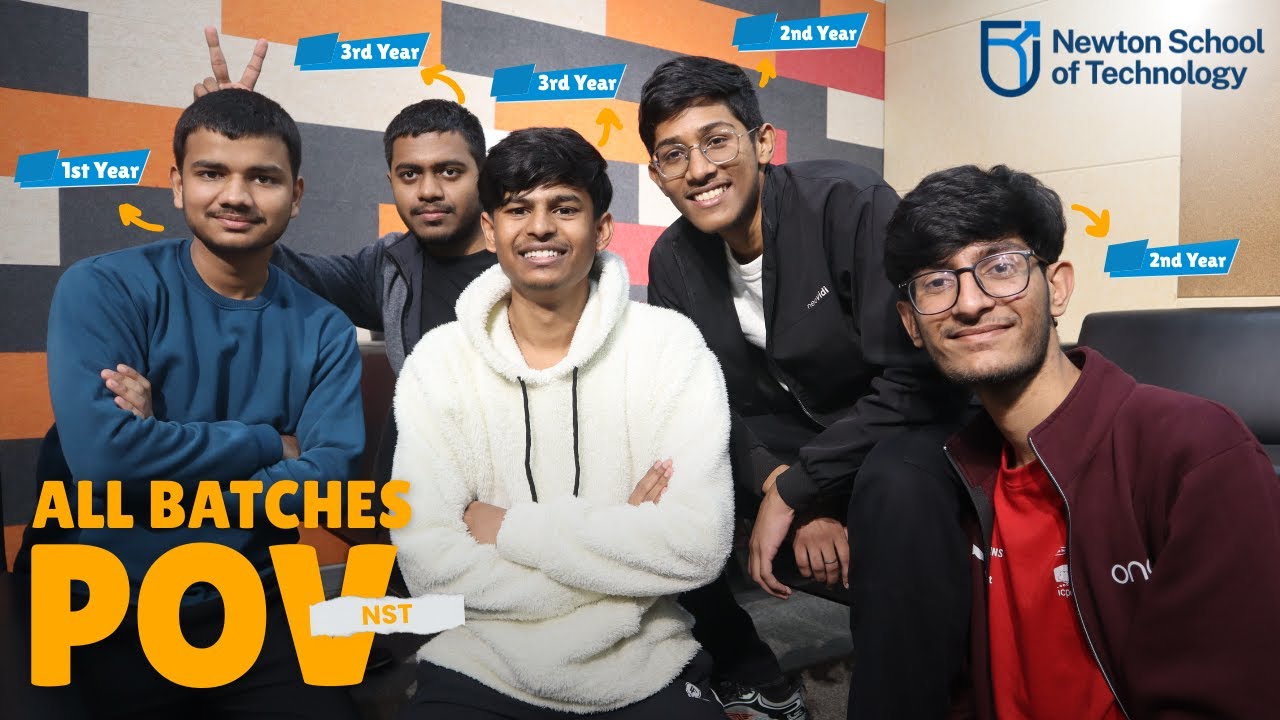
In this candid panel discussion, Ritik Raj sits down with students from three different years at Newton School of Technology (NST) to unpack a simple but powerful question:
What did we expect, and what actually happened?
The answers aren’t sugar-coated. They’re reflective, sometimes uncomfortable, and surprisingly reassuring.
Who’s on the Panel?
The discussion brings together voices from different stages of the NST journey:
- Amod Ranjan — Third Year
- Jigyasu Kalyan — Second Year
- Satyam Singh — Second Year
- Krishna — First Year
That mix matters. College looks very different depending on how long you’ve been inside it.
Why NST in the First Place?
For many students, NST wasn’t the first plan — it was the next plan.
Lower-than-expected JEE ranks pushed them to explore alternatives beyond traditional colleges. NST stood out because it didn’t try to look traditional at all.
What attracted them was the promise:
- A next-gen, industry-aligned curriculum
- Exposure to real-world tech instead of outdated syllabi
- A college that openly said: “This will be different.”
Some students joined knowing they were taking a risk. NST was new. There was no long placement history, no alumni safety net — just a curriculum that felt aligned with where tech is actually heading.
Krishna, a first-year student, joined after seeing a reel. It sounds casual, but that reel led him to read the curriculum — and that is what sealed the decision.
Not rankings. Not brand names. Content.
Did Reality Match the Hype?
Short answer: mostly yes — sometimes more.
Amod talks about how NST pushed him deeply into Competitive Programming (CP), something he hadn’t even fully planned on initially. The structure and exposure forced growth beyond expectations.
Jigyasu joined with a simple goal: a decent package and curiosity about ML and robotics. Along the way, CP completely pulled him in. His verdict is clear — joining NST was his best decision. Not because it was easy, but because it forced clarity.
Krishna, still early in his journey, feels NST has delivered on what it promised so far. No rude shocks. No major disconnect between marketing and reality.
Competitive Programming: Why Everyone Talks About It
A large part of the panel is involved in NST’s CP culture.
They describe it simply:
Competitive Programming is like a sport for problem-solving.
You race against time, constraints, and your own limits.
It’s not mandatory at NST. But once you get into it:
- Your thinking becomes sharper
- Patience increases
- Ego disappears very quickly
It’s demanding — but transformative.
First Semester: Faster Than Expected
Almost everyone agrees on this point: the first semester flies by.
- New events happen constantly
- Everyone initially knows everyone
- Friend groups start big… then shrink naturally
By the second semester, most students settle into a small, solid circle. Less noise. More focus.
Jigyasu shares a relatable shift — he tried being highly extroverted initially, then consciously pulled back to focus on work. NST doesn’t force a personality on you. It lets you recalibrate.
Amod highlights something subtle but important:
With only around 100 students per batch, the campus can feel quiet — but that same small size enables real one-on-one mentorship with faculty. Less crowd. More access.
Coming With (or Without) Coding Experience
This is where reality hits hardest.
Students who entered NST with prior coding experience clearly had an advantage:
- Lower academic pressure early on
- More time for clubs, CP, and side projects
Those without prior exposure had to grind harder just to catch up.
Amod openly admits this struggle.
Satyam’s story offers contrast — he learned Python in just 1.5 days for his NST interview, then went on to complete most of Harvard’s CS50. That preparation made his first semester significantly smoother.
The takeaway isn’t guilt — it’s awareness.
Early exposure builds confidence, and confidence fuels momentum.
Internships, Placements & Long-Term Thinking
The panel doesn’t pretend internships are easy. Rejections have already happened.
CP-focused students believe their deep problem-solving skills will matter long-term, even if early-stage startups prefer web developers. There’s confidence here — not arrogance — that skills can be adapted when needed.
Satyam’s approach stands out. Instead of chasing internships aggressively, he’s prioritizing ICPC-style growth and CP depth, betting on long-term payoff over short-term validation.
Advice for Future NST Juniors
The advice is practical — no motivational fluff:
- Learn Python or HTML/CSS/JS early for faster internship readiness
- For higher packages and long-term growth, start CP + DSA (C++/Python) early
- Keep an open mind — don’t lock yourself into one path
- Study basic concepts before joining to reduce pressure
- Bring homemade food initially — hostel food takes time to adjust to
Final Thoughts
NST isn’t portrayed here as a miracle college.
It’s portrayed as a demanding environment with real upside — especially if you’re willing to work, adapt, and think long-term.
The biggest gap between expectation and reality isn’t infrastructure or curriculum.
It’s how much responsibility shifts onto you once you enter.
And maybe that’s the point.
NST doesn’t promise comfort.
It promises opportunity — and then quietly waits to see what you do with it.